
Know the Difference between BS3 and BS4 Engine
When it comes to emission norms and engine changes,it is certainly a major technological shift because any change to the engine will reflect on the overall efficiency and performance of the vehicle.
Bharat Stage (BS) Emission Standards
As the world realised the growing importance of reducing carbon footprint and countries adopted stringent measures for controlling polluting vehicular emissions, India too introduced stricter emission norms. Bharat Stage Emission Standards (BSES) were first put in place in 2000 by the Government of India, in a bid to control air pollution from vehicular engine emissions.
For BS standards to be followed, updating the engine from previous to next-gen becomes necessary. So what does the shift from an earlier standard to next-gen BS emission norms really mean as far as vehicle product development is concerned? And how does it impact the crucial engine construction and performance?
New BS Standards for Auto vs. Construction Equipment (CE) Vehicles
Firstly, the transition in BS emission norms has been done in a calibrated manner keeping in mind different categories of vehicles and engine type.
From April 1, 2020, there has been nationwide implementation of Bharat Stage VI or BS6 norms (moving from BS4) for all new 4-wheelers manufactured, sold and registered.
However, the same norms are not applicable for the construction equipment industry where the shift in BS emission standards has been from BS3 to BS4. Also, as announced recently, the revised implementation date of BS4 norms in construction equipment vehicles is April 1, 2021 instead of the earlier ruling for October 2020.
For manufacturers, complying with the updated new regulation is in fact an opportunity to introduce latest and improved technology in their vehicles. Construction equipment vehicles will now be fitted with a BS4 diesel engine to replace the earlier BS3 diesel engine.
BS3 vs BS4 Engine
So let’s get into the nuts and bolts to understand the difference between BS3 and BS4 engine and how the phasing out from old to new-gen will affect engine performance.
At a top level we need to understand that a BS4 engine is able to manage and control evaporative vehicular emissions much better than a BS3 engine, resulting in a cleaner, less polluting vehicle.
Take a look at the change in emission levels from BS3 to BS4 for CE vehicles based on their engine power output.
| POWER RATING | BS3-CE VEHICLES | BS4-CE VEHICLES | ||
| HP | NOx + HC | PM | NOx + HC gms/KM | PM gms/KW |
| ˂10.72 HP | 7.5 | 0.6 | No Change | |
| 49.61 HP ≤ 75 HP | 4.7 | 0.4 | 4.7 | 0.025 |
| 75 HP ≤ 174 HP | 4 | 0.3 | 0.4 + 0.19 | 0.025 |
The big change is about 90% reduction of PM (particulate matter) in BS4 engines higher than 50 HP. The highly toxic Nitrous Oxide (NOx) vapour emissions go down by a whopping 92% in BS4 engines higher than 75 HP.
BS3 vs BS4 Diesel Engine
The major technology shift is that BS4 diesel engines have to use the more advanced common rail technology instead of the old direct injection technology. Although, most OEMs had already made the shift to Common Rail Direct injection (CRDi) when BS3 was announced. This was necessary so that their diesel engine powered vehicles were compliant with the new emission standards.
Another important change now to meet BS4 norms is that BS4 diesel engines have to be fitted with a bigger more powerful catalytic converter known as a Diesel Oxidation Catalyst(DOC). This mandatory fitment in diesel vehicles makes the fuel combustion process more efficient and reduces emission of harmful hydrocarbons and carbon monoxide.
Also, all diesel vehicles in the new BS4 era have to be fitted with an Exhaust Gas Regulator or EGR, and a Urea injector called Selective Catalytic Reduction (SCR). The latter cuts down NOx vapour emissions by breaking it down and converting NOx molecules into Nitrogen and H2O.
Apart from adopting newer engine technology, there are electronically-driven changes too when it comes to differences in BS3 and BS4 norms. To be deemed BS4 compliant, vehicles need to have On Board Diagnostics (OBD) whereby an in-vehicle electronic panel will continuously monitor engine performance and display the vehicle’s vital stats in real time.
In conclusion, it needs to be appreciated that for the construction equipment business, conforming to the new BS4 standards as per stated timeline, has led to manufacturers making huge investments in expensive technology, leading to the benefit of an entire latest gen of advanced machines.
Attachments for your Mahindra EarthMaster backhoe loader
It is the basic requirement of any construction site. Any construction project be it big or small cannot be think without a backhoe loader. This diversity of backhoe loaders can be multi folded with the addition of specific attachments for specific construction jobs. These attachments enhance the machine utility to even greater extent. The beauty of these attachments is the flexibility of attaching and detaching them as per the job requirements. We will explore some of the attachments which can enhance the utility of your Mahindra EarthMaster and can give you more out of your machine.
Rock Breakers: One of the major and widely used attachment in construction machinery are rock breakers. By the word itself we can understand that these are used to break rocks. The attachment is majorly used in stone quarry and mining application. They can also be used for demolishing purpose, breaking roads for pipelines, breaking hard surface for mugging top strata of land. The breakers are easy to install and remove. And the machine can work half time with backhoe bucket and half time with breaker. Thereby with an expert operator you can get the outcome of two machines from one Mahindra backhoe loader having breaker and backhoe bucket changed as per requirement. With breakers it is advisable to reduce the hydraulic service interval as per the usage of rock breakers with any construction machinery.
Auger: It is an attachment which resembles a drill but is bigger in size and is operated by hydraulics. The role of auger is to drill a hole in construction sites mainly for pillars, base of a building, to check the material below where the construction is taking place. These can be mechanical also which are used manually. They are used in almost all construction projects, real estate agriculture, roads, railways, electricity department etc.
Dozer Blade: it is a specific attachment built for dozing of loose materials. This dozer blade attachment is not so famous as the loader bucket can also perform the task of dozing. But in specific applications where the material is loose and abrasive companies design dozer blades which can be put in place of loader bucket and then your backhoe loader can be used as a dozing equipment. We need to take care that backhoes are generally not meant for dozing.
They are meant to lift the things and then move around. Hence the attachment cannot replace the use of bulldozer where the material to be dozed is very heavy. A dozer blade can be used in levelling, back filling of excavated area, ash handling, agriculture, land development, ice removal in colder regions, etc.
Forklift: Typically, a forklift is a combination of electrical and hydraulic mechanism. The idea of forklift is to lift things to be placed on higher levels. Forklifts are mainly used in assembly lines, factories, big malls, godowns, storage area etc. But when the material you are handling becomes heavy and big you need a bigger forklift.
Or simply you can put a forklift attachment in place of loader bucket in your Mahindra backhoe loader. In bigger construction sites this attachment is very versatile in handling bigger machinery parts. With a stage it can also perform as a platform for service personals to conduct repairs at heights.
Jib Cranes: Jib crane is a local substitute of bigger crane. It is used to lift not very heavy loads but loads which cannot be lifted by humans and require machines to lift.
They are substitute for random crane works at sites where cranes are not that frequently used. Hence the project cost is saved by not purchasing an extra equipment for lifting job which comes sometimes and random. Where there is requirement of full time lifting a separate crane must be purchased. The attachment can be mounted in place of loader bucket.
Ripper Tooth: As the name suggest it is an attachment which is used to rip the hard surface area. Majorly used in the road application to remove the old road surface when it is to be replaced with new roads. The ripper tooth is specifically manufactured with harder material and is less prone to abrasion. It is an extremely specific tool and is used in some specific construction sites only.
Six in one bucket: it is a form of loader bucket mainly used where the application requires many operations in the same job sites.
It can perform digging, loading, dozing, grading, backfilling and grabbing six such jobs which a normal bucket cannot do. Hence the name evolved as 6 in 1 bucket. Can be used in all applications and industry likes road, real estate, quarry, mines, agriculture, factories, etc. this type of bucket is very famous in government organisations like municipal corporations and PWD.
Sugar Cane grabber: this bucket is specifically designed for handling sugarcane in sugarcane industry. By study it was found that Backhoes are expensively used in sugarcane industry for handling sugarcane and other disposable material. The bucket is designed like a big fork which can grab sugarcanes like noodles and can manage them effectively. This sugarcane grabber attachment has a specific market and can be easily installed in Mahindra EarthMaster.
Ditch cleaning bucket: This ditch cleaning bucket is majorly used to clean the canal, ponds, city drainage or any waterlogged lanes. The bucket is slightly broader and has sieves on the bottom surface which allows water to pass through and selects the mug to be removed. It is very much preferred in irrigation department and local municipal corporations. Also, can be used in flood affected areas.
Pole Erector: A special pole erector attachment designed for PWD, electrical department to make their work easy. The contractor having this attachment will finish the layout of electricity supply through poles in no time. This attachment is unique and application specific.
Conclusion
These attachments when bought separately with the standard machine can makes one’s business ready for all type of construction projects. Mahindra EarthMaster when combined with all these attachment makes it almost impossible to not able to do any construction jobs. The attachment when included in the machine makes it a complete package to any project. It also substitutes some of the machinery which do not have main line jobs in project sites like cranes, augers, forklift and saves a lot of cost involved in the project. When wisely selected these attachment helps in making construction project more profitable.
Evolution of Backhoe Loaders
Introduction
A backhoe loader, also called a loader backhoe, digger in laymans terms, or Informally shortened to backhoe within the industry, is a heavy equipment vehicle that consists of a tractor-like unit fitted with a loader-style shovel/bucket on the front and a backhoe on the back. Due to its (relatively) small size and versatility, backhoe loaders are very common in urban engineering and small construction projects (such as building a small house, fixing urban roads, etc.) as well as developing countries. This type of machine is like and derived from what is now known as a TLB (Tractor-Loader-Backhoe), which is to say, an agricultural tractor fitted with a front loader and rear backhoe attachment.
The true development of the backhoe began in 1947 by the inventors that started the Wain-Roy Corporation of Hubbardston, Massachusetts. In 1947 Wain-Roy Corporation developed and tested the first actual backhoes. In April 1948 Wain-Roy Corporation sold the very first all hydraulic backhoes, mounted to a Ford Model 8N tractor, to the Connecticut Light and Power Company for the sum of $705.
Before Backhoe
The major job and initial job of construction activity is to build a base of any infra structure. This involves digging. Before the backhoes, the construction activity of digging is done by humans with the help of handmade shovels. This method is neither safe nor is very time consuming. Also, the accuracy of the jo is not good. Further the cost per cubic meter is very high. There are many other small problems related to human behavior are there. There is a crucial need of a machinery which can increase the per cubic efficiency of any construction job.
Evolution of a Backhoe Loader
As the Darwinian theory gives us a clear distinction between the various phases of our evolution of humans, some blurred boundaries are available for the evolution of backhoe loaders too. There was a trend of evolution since the inception of their usage and nobody knew that a single use equipment attached to a tractor will develop into a full-fledged machine which will act as a one-man army.
1. The first one (1940)
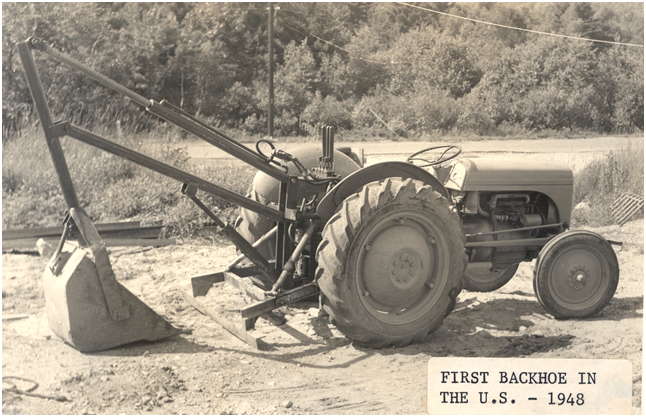
The first backhoe loader back in the 1940’s with just one hydraulic attachment which is the loader bucket.
2. The second Variant in 1948 with a backhoe bucket
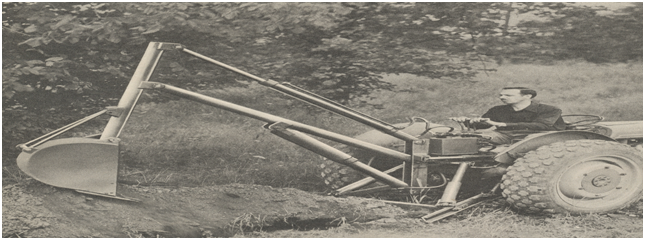
This is the first draft with a backhoe apparatus which is the small bucket, this was the time when the creators got the equipment patented along with some extra information which was later developed into more prominent parts of the machine. However, one important point is that the technology still did not allow them to use both the buckets at once.
3. TLB (Tractor-loader-backhoe)
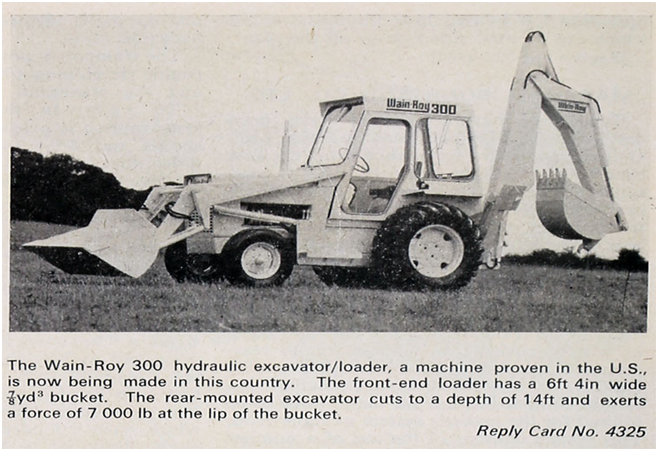
The first TLB which had the capacity to do multiple operations dated back to 1952. The machine in picture is the Wain-Roy 300, a very primeval and prominent machine which was the first authentic patent of its likes.
4. 180 Swing Backhoe Loader
While Wain-Roy was making advancements in North America, JCB was paving the way for the future of the backhoe-loader in Europe. In 1948, JCB launched the first European hydraulic loader. The Major Loader was a front loader designed to bolt onto a Fordson Major tractor. This was followed in 1953 with a backhoe having a 180˚ swing fitted to a tractor.
5. Integrated TLB (1957)
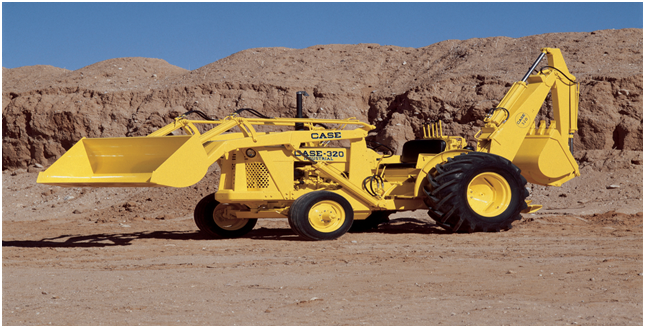
Case produced the first “integrated” TLB in the U.S., with all components manufactured and warrantied by the same manufacturer.
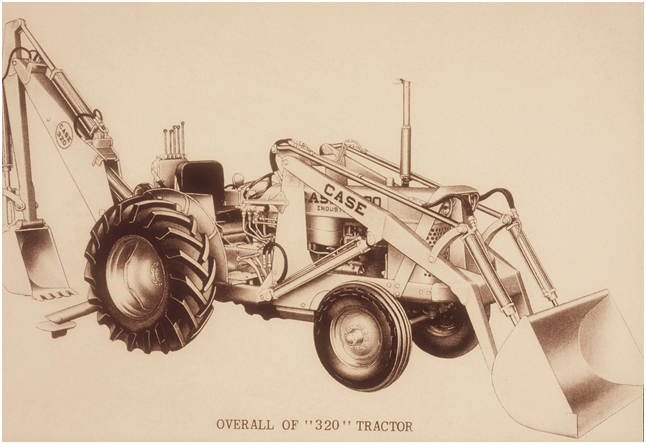
6. Case’s more advanced Machine
The 320 tractors.
7. In case you are already wondering what future looks like, Mahindra Backhoe loaders give that taste in the present, one of them is featured towards the end of this article.
Uses and salient features
While we have mentioned some generic features of this equipment in a previously dated article, in this piece we will be telling you about the paradigm shift which the equipment has endured and how it actually becomes the need of the hour when we place the economic conditions of the country in foresight.
1) Versatility in the state of Economic Turmoil
The falling budgets and the lack of financial support to small businesses and MSMEs force them to decrease their labor cost since this is the only variable cost, they can change. A multi-function backhoe loader can perform a lot of tasks and can be availed once and for all thus reducing the recurring log of expenditure.
Be it the construction of a small house or fixing a patch of broken road, a backhoe loader is a common sight of everyone who passes a construction site.
2) Easy usage for the operator
The cabin for the operator working inside the backhoe is spacious enough to accommodate him and few of his belongings easily. It also has good leg space allowing the operator to stretch his legs after working for long hours. This added feature increases the productivity and gives this machine a competitive edge against a single utility equipment. The most important part of this machine is its engine which is super tough. However, the quality also depends from companies to companies and therefore someone who buys the loader from a reputed brand will always find his money worth the machine.
3) Complete Automation of the operations
There is potential for further automation, as well. “Currently, automation will help on operator comfort, and saving time and money in terms of fuel. What we are inclined to see in the future is not only the feature automation but application or operation automation.
Examples
a) Return to Dig function
The operation that will automatically lower the bucket as the operator approaches the pile. “But there are still components in that application that you can automate — for example, raising the arms close to the truck, dumping the bucket, returning the bucket to a position where the return-to-dig can engage.
b) 2D Grade System
There are technologies available today that can be equipped on a backhoe for a 2D grade system. Such systems can help eliminate the need for a grade checker in the trench. More advanced grade control systems with a higher level of precision and automation may also emerge on these machines. “Implementation of electro hydraulic controls can significantly improve the efficiency, preciseness and reliability of many features offered today.
4) Durability and Endurance
As the engine’s capacity is always getting better, the consumer welfare is also kept in mind while advancing the R&D. The makers have now ascertained that the thought before procuring the machine is not for a momentary purpose but a long-lasting goal which can be associated with the intention.
The machines are built to maximize the productivity and to endure all the on road and off-road burden while still being fully optimized and functional.
5) Customer’s Direct Access
With the marketing philosophy now being changed to the paradigm where after sales and quality is prominent and not the quantity, companies have started to focus on crafting the tech of the product as per the need of the consumer. Since the decision-making authority lies with the buyer and there are several options available, what intrigues the customer in a hearty manner is the involvement they have with the machinery and how they can also follow the trajectory of operations.
The levels of integration have risen, and the customer has now been put directly in the operator’s seat without being there physically but by tracking every hook and corner virtually. While some customer does follow the conventional approach and don’t want any improvement, the companies are thriving hard to strike the requited balance.
6) Pilot and Electrohydraulic controls
May it be the wobble stick or the EC and AEC, everything has been focused in order to enhance the productivity per unit of time. The extra efforts to increase the magnitude of EHC has landed the companies in a pool of profits and the contractors in a pool of saving their resources.
While the above points tell us about the current and future modern improvements in the backhoe loaders, the safety standards, easy accessibility, and cost efficiency has been rising with each future generation of the loaders.
Why Mahindra EarthMaster?
Mahindra EarthMaster is not just a machine but is an overall powerhouse which can boost your business’ productivity with its usage. It was born after over 4 years of research and over 20,000 hours of machine testing under the harshest conditions, has set new benchmarks in the 79.89 HP Backhoe Loader category.
Mahindra EarthMaster is a substantially more superior machine, with greater reliability, dramatically less maintenance, better operational kinematics and dynamics with a phenomenal fuel efficiency that saves at least 4.5 liters per hour.
It comprises of the best in class engine which is fully equipped and is extremely powerful. This machine is tailor made for easy operations so that everyone who has the basic skills to use such machines can get this and make the best use of it.
The backhoe operations are conducted with a joystick which makes the interface very easy while the whole cabin experience is very comfortable for longer hours of labor. The machine is also in consortium with technical advancements and can be associated for updates on your devices.
The extensive brochure can be accessed via this link
So, now we know why we really need a backhoe loader and why Mahindra EarthMaster becomes the ideal choice to take your business to the apex of the construction world.
Most Diverse Construction Equipment
Construction Equipment
Almost every construction job be it domestic, large scale commercial and civil project are not possible without Construction Equipment. The bigger the project the bigger is the size of machinery required. Heavy equipment is essential for construction jobs. Earth-moving equipment covers a broad range of machines that can excavate, demolish, transport, grade soil and rock and lift along with other jobs. Construction equipment big or small help to speed not only in Construction but also in earth work, materials handling and demolition. Many types of heavy construction equipment are designed for multiple functions, making them indispensable on job sites.
Backhoe loaders
Backhoe loaders, often called backhoes, have main body of a farm tractor and include a loading shovel in front and a small bucket in the back for digging. Backhoe loaders are considered medium-sized construction equipment for smaller jobs and can work in limited space to perform various operations. They can move dirt, do excavations, dig holes and trenches, can be used as cranes to handle material, pipe laying, filling of pit and levelling material. One of the best attributes of backhoe loaders is that they are wheel-driven and can be moved within the city on concrete roads without damaging them. They can even be driven to a job site. Backhoe loaders do not require a separate transportation arrangement for them from one site to another.
Importance of Backhoe loaders
Backhoe loaders are the most diverse type of Construction equipment available today. They are also known by different names around the world; the term digger, backhoe, excavator backhoe, all refer to the same equipment. In general, a backhoe can be described as a machine with a shovel or loader bucket unit on the front, with a backhoe on the back. Due to their start from farming tractor equipment, backhoe loaders have a tractor-like look about them.
Although various manufacturers offer backhoes in several sizes, they tend to be relatively small in comparison to other type of heavy equipment. Their size is one element which lends to their popularity; their versatility is another. Backhoes are considered as a backbone of any project as it can also act as an alternative to other machinery in case of breakdown. For average sized jobs a backhoe an replace an excavator, dozer, grader, crane and many other jobs. In all backhoes never leave a site in standstill.
Diversity
The number of attachments for and applications of the machine makes it diverse. Backhoes can be found on construction sites big and small, road building projects or excavation and earthmoving sites. Smaller backhoes can be easily used for small landscaping projects; large backhoes can be utilized on demolition projects.
The backhoe bucket in the back can be changed to dig trenches of different widths. Also, there are varied attachments developed from time to time for this machine which can be used for specific application. Typical example of some attachments is trenching buckets of different sizes, breaker, auger, Sugarcane handler, Pole setter, forklift, etc. You name the application and industry can design an attachment for backhoe.
These attachments are easy to fit and remove. A single machine can be used to many applications just by changing the required attachment. This ability of backhoe loaders makes them versatile and diverse machine. Multi-functionality and versatility keep backhoes popular as an important piece of equipment in the construction, agriculture and landscaping industries. Almost every construction project bigger or small have backhoe loaders as a must have product in their fleet.
Apart from the multifunctional aspect, the ideal size of backhoe loader which is neither too big for small jobs nor too small for average heavy jobs makes it easy to handle. Further its ability to move on tyres makes it easy to transport.
Most popular among Construction Equipment
With this diversity and flexibility Backhoes are the most popular construction equipment globally. They are always in demand and are known to big, small, relevant or non-relevant every person around the world.
Use of a Motor Grader in Road Infrastructure
The most important growth that a developing country like India can have is road construction.
Roads play a major role in a developing economy. It not only improves the efficiency of an enterprise or a whole industry but also does it by supporting an increase in logistics and other profits. One of the major machines used in improving roads is a Motor Grader, while other important construction equipment’s include smaller graders, usually referred to as mini graders and Backhoe Loader.
Backhoe Loader
A standard Backhoe Loader typically encompasses
1. A large bucket that is attached in the front and is used generally for landscaping, breaking asphalt, providing stability while working, and myriads of other operations like construction, small demolition, etc.
2. A backhoe that is attached to the back is used in digging and small engineering matters in urban areas.
Backhoe loader from Mahindra Construction equipment, the EarthMaster, provides a 7% more reach with extended banana boom feature, hence increasing productivity. Other features include a DITEC engine which allows 10% more savings with Mahindra’s backhoe loaders.
Motor Graders
A Motor Grader is a type of construction equipment that is designed specifically for road construction. It can perform tasks such as grading, levelling a rough surface, evenly spreading dumped material, trenching and of course, creating smooth roads for us to travel.
Motor graders are also used in mines to maintain and modify the rough and unpaved roads continually for the heavy mining equipment.
A motor grader consists of
1. A blade used to create flat surface during grading for road construction. The size of the blade can be adjusted based on the location of the construction, Mahindra’s RoadMaster offers a 3000 mm long blade which can be adjusted depending on the requirement by 200 mm on both sides.
2. Although most graders have tandem axles Mahindra’s grader does not possess it. An ingenious design by Mahindra allows the RoadMaster to achieve the same quality of finish without the use of bulky tandem axles.
3. Apart from the above, non-inclusion of other features like a 90-degree rotation of blades, has allowed Mahindra Construction Equipment to reduce the cost to almost half the price of traditional graders while not compromising on either the efficiency of the machine neither the quality of the construction work.
4. Ripper, an optional attachment to a grader, allows the grader to dig-up and loosen a patch of road before grading it. This saves the cost of employing a backhoe or an excavator to do the same job.
5. Dozer, another optional attachment, allows the grader to break larger heaps and spread material faster. Dozer is also useful is clearing boulders and other debris from the road and other miscellaneous tasks. Whenever a grader is trying to move a heavy object, an operator should avoid doing it with the grader blade, instead, the dozer blade should be used.
Both backhoe loader and motor grader are widely used in urban engineering setup, especially in developing countries for the construction, demolition of small houses, grading roads, construction of roads and road repair. Mahindra Construction Equipment has tested these machines for over 10,000 hours to ensure quality for the customer. Additionally, the RoadMaster was purpose-built for the Indian territories and hence provides the maximum efficiency, both in terms of fuel and maintenance.
Difference Between Motor Grader and Bulldozer
These equipment help in completing various tasks on the right time, thus, putting an end to project delays. While some equipment may look different but perform similar functions but some may be very different on both the grounds. Whatever is the case, it is very important to have basic understanding of the various equipment that you are planning to use at the jobsite. You need to know that what tasks are performed by different equipment as this can help you to choose the best fit for your tasks.
For example, bulldozers and motor graders are very different piece of equipment and there is no similarity in their appearance but there is still some overlap (although very small) between their function. And for a newbie in the business, it might look like any of the two can be employed for a given task, which is absolutely a wrong notion as what motor graders can do precisely, bulldozers can’t. Hence, it is important to know which one to choose depending on the requirement.
What is a bulldozer?
Also called as dozers or crawlers, bulldozers are powerful equipment which are largely employed for shifting huge amount of dirt, sand or debris on jobsites where there is wide open spaces. They are also used for rough grading and grinding rocks. Bulldozers are generally found on jobsites including general construction, road work and other types of infrastructure sites, mining, farms and forestry.
Bulldozers come in two variants i.e., with tyres and tracks. The tracked bulldozers are ideal for moving over rough and off-road landscapes. Operated via a four-wheel drive system with articulated steering and an articulated blade, wheeled bulldozer is the second type of bulldozer.
Bulldozers generally come up with two key components i.e., a blade and ripper.
1. Blade: Used to push materials, blade is the large metal plate which is attached to the front of the bulldozer. It is used to push large quantities of material such as soil, rubble and sand.
2. Ripper: Shaped like claw, ripper is found on the back of the bulldozer and is used to rip, break and loosen compacted material for easy removal.
What is a motor grader?
Also called as road grader or grader, motor graders are multi-purpose equipment and basically used to level or smoothen out an area. They have a long wheel base that can span short depression or humps. Typically, motor graders possess a centrally located blade (which sits between the vehicle’s front and rear axles) that can be angled to cast out on either side. Motor graders come with various attachments to perform multiple tasks.
Typically, graders are used to perform jobs including…
1. Creating base layer for paved roads
2. Setting the foundation for the base of large building projects
3. Creating inclines
4. For making drainage ditches
5. Removing snow and debris
Motor graders are majorly used in road construction and maintenance which includes public roads as well as roads on mining and construction sites.
Bulldozer and Grader: What’s the Difference?
There are some key differences between bulldozers and motor graders. You should know as to which one to use when. Let’s look at the major differences between them…
For rough grading purposes, bulldozers are the best. Typically, bulldozers does not have the capability and precise control for achieving fine grade which is not the case with the motor graders. Further, bulldozers’ tracks provide an exceptional ground holding capability and mobility on rough surfaces. Since, the tracks of the bulldozers are wide, this helps them in distributing its weight over a large area and this decreases ground pressure. This also helps the bulldozer to move across sandy and muddy terrain. It is due to these reasons that bulldozers are best suited for jobs at construction, mining, land clearing, road building and infrastructure development and forestry projects.
On the other hand, motor graders are best suited for large projects which need detail and precision. Motor graders come handy when working in open areas. Motor graders are majorly used for finish grading, shaping, ditching, mixing, spreading, side-casting, levelling, crowning and creating inclined surfaces. Motor graders can even be used to move small amount of materials like dirt etc., but they cannot move large or heavy loads unlike the bulldozers. This is majorly due to the physical size and the blade location of motor grader which makes it unsuitable for moving heavy materials.
Buying motor graders
So, depending on the need, type of work and jobsite, the equipment should be chosen. Bulldozers and graders are manufactured by many companies worldwide. Talking particularly about motor graders in India and indigenous manufacturers, then Mahindra Construction Equipment (MCE) tops the list. MCE offers two variants of motor graders i.e., RoadMaster G75 and RoadMaster G90 which are best suited for Indian needs and jobsites.
RoadMaster G75 offers affordable, un-compromised and mechanisation for grading best suited for small and medium roads in India and is an ideal grading machine for spreading and grading of earthwork in PMGSY & rural roadwork across the nation. It is also best suited for the maintenance of earth and gravel roads in India. On the other hand, RoadMaster G90 is a Simply Optimal machine apt for slightly bigger projects like state highways and national highway expansion projects, railways, flyovers etc.
In a nutshell
Both bulldozers and motor graders have different functionality and are not a replica of each other. So, it is necessary to understand the two equipment well and use them as per the need.
Check out The History of Motor Graders
Today, motor graders are used extensively in construction, road building and maintenance and even at mining sites.
Before diving deep to know about the history of motor graders, first we need to know as to what is a motor grader? Well, also called as a road grader, patrol or maintainer, motor grader is a piece of heavy machinery used for creating smooth, wide, flat surface. Typically, motor graders are used for fine grading, spreading and earthmoving. These days, motor graders are also used for clearing debris and brush, as well as for snow removal. With a variety of attachments, motor graders can actually become very versatile equipment.
A small motor grader within a range of 80-150 horsepower is perfect for jobs that need to be completed in a tight spacing environment, while larger motor graders can be used in broader spaces. Motor graders are broadly classified into two categories based on the structure and arrangement of the frame i.e., Rigid Frame Motor Grader and Articulated Frame Motor Grader. Of the two, the later is the most commonly used version these days.
Tracing the origins of motor graders
1. Horse-drawn graders:
The earliest known graders were drawn by horse or oxen and consisted of simple steel frames fitted with wheels and a fixed-angle blade. This type of grader was invented in 1885 by Joseph D Adams, in Indianapolis and was named as ‘Little Wonder’. It was made using leaning wheel principle with two wooden wheels and a blade set at a fixed angle.
After few years of this development, in 1896, Adams introduced a new kind of motor grader which was a four-wheel and all-steel grade horse-driven motor grader featuring an eight-foot blade and wheels capable of leaning in either direction. This model was called the ‘Road King’.
2. Tractor-drawn graders
Gradually, by the early 20th century, steam tractors replaced the horses and oxen and were seen pulling the graders. Later, crawler tractors were used to pull the graders.
3. Motorised graders
It was in 1919, when Russell Grader Manufacturing Company developed the first self-propelled motor grader which took the form of a modified tractor. It was marketed in the year 1920 as the Motor Hi-Way Patrol No. 1, a grader that consisted of a modified Allis-Chalmers tractor. Seeing this, other tractor manufacturers during that time i.e., McCormick Deering, Fordson and the Cleveland Tractor Company also started modifying tractor designs to incorporate built-in graders.
In the year, 1928, the company Caterpillar which specialised in manufacturing tractors bought Russell Grader Manufacturing. Then the company launched Caterpillar Auto Patrol in 1931 which was a dedicated motor grader with a drivetrain and grader designed as a single unit. Unlike earlier models, the Caterpillar Auto Patrol featured rubber tyres rather than crawler tracks. It became the prototype for all subsequent motor graders. Then, various manufacturers emerged on the scene and continued refining and improving on the grader designs.
Blade control advancements in motor graders
Before 1920s, grader blades were controlled by hand cranks, racks and pinions which were primarily operated by wheels in the operator’s station. However, in 1920s, many manufacturers began developing power controls. They introduced mechanical power controls and once the technology was widely available, hydraulic controls came in. It was in 1935, when Adams launched a motor grader with a blade that could extend sideways making it possible to trim banks and shoulders.
The growth of large sized motor graders
After World War II, not only did the demand for motor graders increased but the size of the equipment also increased. This need arose overlooking the potential uses of graders in industries like mining and in highway construction. This large motor grader trend began with the Galion Iron Works Manufacturing Co.’s production of the T-700 model in 1955. This grader set a size record at that time by weighing more than over 40,000 pounds (18,143 kg) with 190 horsepower and including powershift transmission with a torque-converter-drive.
Later in, 1969, another massive motor grader, the double-articulated Autoblade, was introduced by CMI Corporation. This machine was 40 feet (12 m) long, weighed 65,000 pounds (29,484 kg) and contained a power module at both ends and whose cab could rotate 180 degrees in either direction. The same year, RayGo Inc introduced the Giant featuring dual-end power and double-articulation. This machine was 106,000 pounds (48,081 kg). In 1975, Champion Road Machinery Ltd achieved the world size record for its 100-T model which weighed 202,000 pounds (91,626 kg), had a 700 horsepower Cummins engine and a 24-foot (7.3-m) blade.
At present, the world’s largest grader is produced by Caterpillar and is known as the 24H. This machine was introduced in 1996. It weighs 137,000 pounds (62,142 kg) and boasts a 24-foot (7.3-m) moldboard.
On-going innovations in motor graders and present scenario
Since its inception, motor graders have changed drastically and the manufacturers have been continuously refining the equipment for the better. The changes that have happened till now include advances in engine and brake technologies, more precise control and greater operator comfort through the introduction of joystick in place of traditional levers. Also, today motor graders are fitted with the GPS technology and latest engine designs for maximum power and fuel efficiency.
If we talk about some of the prominent indigenous motor grader manufacturer in the country, then Mahindra Construction Equipment (MCE) with its RoadMaster G75 motor grader tops the list. RoadMaster G75 is one of the most affordable and incomparable equipment in its category in the country at the present. The equipment comes with GPRS based remote monitoring system dogosense that keeps a track of your machine with the touch of a finger. Further, its 3000 mm mouldboard comes with an option of having its size reduced by 400 mm. Depending on the requirement, the blade size can be reduced by 200 mm on bot sides. The cutting edge has a lasting life of about 600 hrs on standard operation cycle. In addition, the RoadMaster G75 comes with the option of having additional fitments i.e., the ripper and dozer for added versatility. The ripper is perfect for ripping hard compacted surfaces before grading while dozer helps with spreading.
To sum up…
Over the years, demand for motor graders has increased drastically. As per Off-Highway Research, the motor grader market is expected to grow from 750 units in 2016 to 850 units by 2020. Also, it is estimated that the demand of motor graders will definitely increase by 15-20 per cent in the next 4-5 years. Thus, indeed future of motor graders looks bright.
Differences Between a Grader Blade and Landscape Rake-Blade
While motor grader blade is used for creating a flat surface or levelling during the grading process, the landscape rake is primarily used to spread and level ground coverings, usually over fairly large areas. Both the grader blades as well as landscape rake-blades can be rear-mounted using a three-point hitch or quick hitch. However, grader blade can also be front-mounted like in case of motor graders which have three axles, with the engine and cab situated above the rear axles at one end of the vehicle and a third axle at the front end of the vehicle, with the blade in between. Even the landscape rake-blades can be front-mounted.
Both the grader blade as well as landscape rake allow hydraulic tilting, angling, raising and lowering when fitted with kits. Depending on their size, both can be used for road maintenance and construction, landscaping, ground keeping, construction or sports field maintenance.
Chalking out the difference between grader blade and landscape rake
Here is a list of all the differences between the two blades…
1. Typically, grader blades are designed for precision scrapping and levelling and thus, they help in creating smooth and uniform surfaces. Sometimes, large grader blades can also be fitted with removable teeth for cutting of the soil. Overall, grader blade can be used for reconditioning driveways, cutting drains and for small areas of levelling. On the other hand, landscape rakes are designed to comb the upper surface of the soil i.e., reshaping and cleaning ground before seeding or rolling. Slightly springy steel tines of the landscape rakes pick up rocks or debris while they groom and distribute soil. For spreading gravel or compost evenly, landscape rakes are the most helpful. Most of the landscape blades have reversible cutting edges for longer life.
2. One of the other major differences between the landscape rake and grader blade is that the former is used to incorporate material into the soil as well as comb it out while the grader blade cuts the material and spread it over the surface and then smoothens it out into an even layer. Typically, the individual tines of the landscape rake separate the soil and allow the material such as compost to incorporate itself.
3. While the landscape rake work by conditioning the soil, grader blade make the surface plain. For removing roots, rocks and other debris that might be in the topsoil before grading, landscape rakes are used. Since landscape rakes can be set low so that its tines can cut soil, they can also separate and aerate it. In simple words, they perform the task of soil conditioning very well. Here it is to be noted that even grader blades cut the soil but they do it by peeling off the surface instead of combing it out. Graders blades generally flatten, reduce height and smoothen out the surface.
4. Both the blades can be used to make hills by angling the blade and building up the material. However, the grader blade is considered to be much more efficient at performing the hilling task because the finer particles cannot pass through it as they can go through the landscape rake tines.
5. Grader blades help in levelling the soil so as to get a uniform layer. Also, grader blades can build up material easily and carry it along to fill holes. On the other hand, landscape rakes can also do that to some extent but are not that useful in this task as soil always passes through them. Thus, instead of building up a layer of soil, they carry along debris like rocks or sticks. However, here the size and separation of the landscape rake’s tines also comes into play.
6. Sometimes, some rakes are fitted with a grading blade inside the tines to allow dual use.
7. While grader blades can be used for ditching, landscape rakes cannot do this task.
8. Landscape rakes are usually strong enough to move tougher materials such as stones and gravel. Even grader blades can work very well on the soft ground or loose gravel. However, if the ground is too hard or the gravel is quite compacted, the grader blade tends to skip over the top rather than cut in. In order to avoid this problem, generally grader blades come with the ripper attachment which can help in loosening up the ground or driveway for making the grading task easier.
9. While grader blades are usually used for road construction and maintenance tasks, landscape rakes can be used for spreading and composting, gathering leaves and other garden debris, removing pond weeds and spreading bark chippings and other mulch. Thus, the landscape rakes are usually good for use with a variety of ground coverings, however, individual rakes have different specifications.
In a nutshell
Both the grader blades and landscape rake-blades have their own uses, advantages and disadvantages. It is your need and requirement which will help you to identify which one to use. Making it simple for you, it is to be noted that for tasks like conditioning, levelling and removing rocks from soil before sowing seeds or laying sod, landscape rakes are used and they come with different specifications. On the other hand, for tasks majorly involving moving, cleaning debris and levelling any material, grader blades are used and they are also available in varying sizes.
So, should you opt for a grader blade or landscape rake-blade? Well, just look at your requirement, gather information about the two and then take the final call!
Purpose Of Using Graders At The Construction And Mining Sites
A typical motor grader specimen consists of 3 axles, the engine, cab and the blade. Graders are generally used for various grains purposes from a rough grading to a fine finish and everything in between. For rough grading, the motor grader can be used as an alternative to scrapers and bull dozers in addition to a few attachments as well. In road construction, the motor graders are used to achieve a fine grade and compaction before laying the asphalt for paved roads.
Motor Rigid Frame motor graders are available in two variants and can be used for different purposes on various sites. One being the rigid frame motor grader: These usually have a single axle and are incapable of moving either left or right amount a point on the axle. This type of graders were popular in the 1980’s and 90’s. the second being the articulated frame motor graders: These usually have both a front and rear axle. The blade is usually located somewhere between the two axles. The articulated frame graders are usually in small places where there is very less space to move and turn about in. Most machines manufactured and used these days are articulated frame graders.
When it comes to articulated motor graders there are basically two types of graders base on the joints. One with the articulation joint in the front of the cab and the other with the articulation joint behind the cab. The grader with the articulation joint behind the cabs provides much better visibility and a clearer view of the mouldboard.
Irrespective of the size of the machine, the general assembly remains the same while the power of the the engine and size of the blade changes with the the size of the machine. Motor graders have heavy use in the road construction industry to create dirt roads and gravel roads in addition to creating a good flat foundation for larger paved roads as well. During construction of paved roads, these robust machines are used to create base surface on which to place the road surface. Native soil foundations pads for setting the roads are set by motor graders. The blade is usually mounted between the front tyres and the axle at the back. The use of the machine rotates around the blade and using it with precision to get the job done. The motor grader if used properly can uplift the quality of the job at hand to the next level if not higher.
We maintained and connected roads play a major role in keeping the mining site profitable and have it working efficiently. Long haul roads in and out of the mine are continuously changing and need regular maintenance. Given the frequent use of the roads across the rough terrain around mines, the roads tend to degrade and deform at a very fast pace. Deformed, degraded roads not only reduce the productivity and efficiency of roads but also add to the expense by damaging the dump trucks that other material handling equipment that keep running in and out of the mines on a daily basis. Bad road conditions add to the wear and tear of the machines being used on the sites there by increasing the costs of operation.
High quality roads help increase the over all productivity at mining sites by minimising deals and slow downs as the haul trucks navigate through the ruts, depressions, potholes or bums on the site. The life span of the haul trucks increases significantly from being used on quality roads. The smaller and frequent wear and tear repairs are also reduced if roads are well maintained. Additionally, quality roads at mining sites help save on the fuel costs that generally run high due to the unmaintained roads. Bad condition of roads add to the risk and incidents of accidents. Good roads are required to ensure that that the equipment and personnel on the site are always safe. Additionally the road it selves require less repair and and maintenance if they are constructed well.
Drills, draglines, loaders and haul trucks are responsible for producing and transporting ore.Several other types of other equipment support the operation of these vehicles.While wheel loaders can be used to maintain haul roads, and tractors with drag boxes can be used to maintain and repair haul roads, a motor grader can do the job more efficiently and cost effectively than these machines.Using a motor grader to construct and maintain haul roads ensures that road surfaces remain flat and smooth with proper drainage, and that these roads are kept free of debris, puddles, potholes, depressions and ruts. Quality roads make it easier to keep work going even in unpredictable climatic conditions like rains and storms too.
When it comes to any kind of construction site, roads are the necessary life line to keep the movement of men, machines and material flowing smoothly to keep the site running efficiently. Motor graders play a major role in quality construction of these roads in and out of the site. Bad roads lead to delays in movement of necessary material thereby interrupting work beyond permitted timelines there by increasing the costs of the projects. Similar to mining sites, if the roads within and around the site arent well maintained and constructed, it may increase the risk of accidents and the danger to the life of the labor on the site while also risking damage to expensive machinery.
When it comes to use of graders on a construction site, they can be summed up as below:
– Trenching, digging trenches for laying pipelines, electric cables and installing drainage systems.
– Spreading of soil and aggregates etc
– Curing of bank canals.
– Ditching, creating ditches for drainage.
– Mixing of two or more materials on the site
– Moving earth from one place to another on the site
– Scarifying, removal of the complete layer of soil and then spreading a new layer at that particular location
– Levelling of soil so that the next bitumen layer spreads uniformly throughout the surface.
– Motor graders can do rough grading that would other wise be reserved for a bull dozer.
– In colder climates, motor graders are used for removing accumulated snow. Due to the normal wheels of the grader, it is better suited for places experiencing above average snow fall.
For most part roads around construction sites in rural areas are unpaved and require regular use of motor graders to ensure that the unpaved roads are maintained. Similar is the case for construction sites in rural places with a difficult terrain. Unpaved roads add to the risk and costs involved in the projects by risking loss of of life and machines in addition to making the sites more accident prone, leaving the businesses open to legal action and monetary penalty in addition to creating a bad reputation in the market.
Motor graders can be used on any site that requires rough and or fine grading for various purposes.
Major Advantages of Using a Multi-Purpose Backhoe Loader Machine on a Construction Site
If numbers are to be believed, then India is by far the largest BHL market in the world, with the equipment accounting for almost 50 per cent of all construction equipment sales in unit terms. Well, why not? Multi-purpose BHLs offer more than one advantage at the construction sites.
A BHL consists of three pieces of construction equipment i.e., tractor, loader and backhoe combined into one unit. All the three pieces of equipment are suited to do various sorts of work. The backhoe tractor is designed to move easily over the rough terrain. While the loader is attached in the front and is designed to do several tasks like picking and carrying large amounts of loose materials from one place to the other and pushing dirt, backhoe is attached at the back and is used to dig up hard and compact material, usually earth or to lift heavy loads. The backhoe has three segments i.e., boom, stick and bucket.
Apart from performing the above mentioned basic tasks, Backhoe Loaders can also do jobs like digging ditches, laying pipes, planting underground cables or laying the foundation for buildings and drainage systems and with few additional attachments, they can do much more. If an augur is attached to the backhoe, it can be used to drill holes for planting trees, signs and fencing projects in a variety of soil types. By joining a bucket for cleaning the ditch on the rear, grading and slope-cutting can be easily done with the BHL. Asphalt cutter can be attached to the backhoe to repair roads. Apart from the above, various others attachments are also available which can be easily attached to the Backhoe Loaders to perform a number of other tasks. Thus, BHLs can be put to various uses.
Overall, with the capacity to perform various tasks, BHLs can offer some major advantages at any construction site. We list them for you…
1. Decreases the need for labour and labour costs: At a time when labour shortage is a major issue in the country, BHLs reduce the need for manual labour as a single machine is capable enough of performing multiple tasks at the jobsite. Moreover, while the manual labour might have the expertise in doing one task only, BHLs are able to perform variety of tasks just with an additional attachment. This helps the companies to significantly reduce the labour costs and even the overall cost.
2. Results in timely completion of the projects: BHLs are not at all affected by any weather conditions and a variety of external factors, hence, they can very well complete the projects on time. Also, they are highly advanced and technologically-sound machines, so they complete the tasks faster and in a smooth way.
3. Leads to accuracy and reliability: Backhoe Loaders allow the contractors to complete the work with minimal quality defects, shielding them from claims arising from poor workmanship. Since today, many construction contracts in India include a defects liability clause, BHLs help the companies in averting any such situation. Also BHLs improve the quality of work by accurately doing every task.
4. Leads to profitability: Increased productivity and the reliability of BHLs ultimately translate into higher profitability. In addition, BHLs also make it easier for the companies to complete their projects within budget at a reduced overall cost.
5. Promotes safety at the jobsite- At any construction site, safety of the employees working on the ground, particularly within confined spaces when heavy materials are being moved around, is a major issue. BHLs put an end to these worries by moving the workers far away from the danger zone.
6. Enhances brand value: If projects are completed on time and with minimal errors with BHLs, the brand value of business increases in the market, which in turn helps the construction companies or contractors in getting new clientele.
In a nutshell
There are clear benefits of using Backhoe Loaders at the construction site. These include improved quality, timeliness, better project financials and safety among others. Hence, it is obvious that the demand for BHLs is expected to grow drastically in the future. In fact, as per Off-Highway Research, sales of BHLs in India is expected to increase from the 21,192 units sold in 2015 to 28,000 machines by 2020, resulting in a 32 per cent increase.
Also, in the future, it is expected that more and more manufacturers will be coming up with the new BHLs model to cater to the growing demand. However, market leaders like Mahindra Construction Equipment (MCE) offering Mahindra EarthMaster BHL model will maintain their firm ground owing to the number of benefits offered by them. In fact, if we talk about the major advantages offered by the multi-purpose Mahindra EarthMaster BHL model, then there are many. Take a look…
1. Mahindra EarthMaster comes with a Banana Boom with 7 per cent more reach as compared to others. This longer travel ensures precise digging in congested or near the wall digging applications, thus, leading to less defects and greater productivity at all times.
2. The joystick-operated effortless power controls that come in the Mahindra EarthMaster can minimise fatigue, thus, allowing operators to work for long hours. Thus, this feature of the equipment can help in reducing overall project’s completion time significantly.
3. MCE’s BHL come with the intelligent feature like REMOTECARE which makes it possible to get business information like daily vehicle usage or health reports, fuel level notice, maintenance warning and other updates through SMS on mobile phones. This makes equipment monitoring quite easy for the managers as well as the operators.
4. The MCE’s backhoe comes with 6-in-1 bucket on the loader which is capable of performing many tasks.
Well, the list of advantages offered by multi-purpose BHLs especially Mahindra EarthMaster is endless. All we can say is that the BHLs can be your best bet for performing a variety of tasks with accuracy at the jobsite.