
Mining Applications of Earth Moving Equipment
Usage of earth moving equipment in mining sector
Various types of construction equipment are used in the mining sector such as hydraulic excavators, wheel loaders, backhoe loaders, bull dozers, dump trucks, tippers, graders, pavers, asphalt drum/wet mix plants, breakers, vibratory compactors, cranes, forklifts, dozers, off-highway dumpers, drills, scrapers, motor graders, rope shovels etc. These equipment perform a variety of functions like preparation of ground, excavation, haulage of material, dumping/laying in specified manner, earth moving, material handling, road construction etc. Among all the equipment employed in the mining sector, earth moving equipment are most widely used.
Various earth moving equipment used in mining applications
Earth moving equipment in any mining project are used to move earth and minerals. While, giant machines such as drills, electric shovels and giant draglines, some of which have buckets that are capable of moving 160 cubic yards of material in one scoop are used for surface mining, complex equipment which can move material in a very headroom and limited space are used in underground mining. The prominent earth moving equipment employed at a mining site include:
- Backhoe loaders: They are versatile, multipurpose machines that can be used as an excavator and as a loader and are seen widely at any mining site. While backhoe helps in digging the trench, loader helps in back-filling it. Given to their huge demand, backhoe loaders are available in various configurations in the market. In addition, an extensive range of attachments are also available which can be easily attached to the backhoe loaders to perform some of the most difficult tasks at the job site such as lifting, grabbing objects, dozing, drilling or levelling the ground.
- Dump trucks/haul trucks: Off-road dump trucks are used strictly off-road for mining and heavy dirt hauling jobs. The more appropriate term for this vehicle is haul truck.
- Track type bulldozer: Bulldozers are a powerful tracked piece of equipment and the tracks give them excellent ground hold and mobility through very rough terrain at the mining site.
- Dragline excavators: These machines are extensively used in surface mining. The larger types are used in strip-mining operations to move overburden above coal and for tar-sand mining.
- Wheel loaders: They are often used in mining operations to load loose materials (dirt, snow, feed, gravel, logs etc.) into or onto another type of machine such as a dump trucks, conveyor belts, feed-hoppers or railcars.
- Scrapers: They are large motorised machines used for digging, hauling and levelling out materials in a variety of mining jobs. Running on massive rubber tires, motorised scrapers quickly move large quantities of earth around a mining site.
- Shovels: These machines are used for digging and loading earth or fragmented rock or for mineral extraction at any mining site.
Keeping in mind, the increasing need of earth moving equipment in the mining applications, the earth moving equipment manufacturers in India are leaving no stone unturned in producing high quality machines. Thus, the future of earth moving equipment segment looks bright at the moment.
Types of Road Construction Equipment
is as high as 15-20kns of high quality roads per 1000 people. While we are on top when it comes to numbers, we lag drastically when it comes to quality of our road network. The Indian state of Gujrat however boasts of high density good quality roads, some of the best in the country. The rest of the country is set to follow suit and develop the roadways at least at par with Gujrat if not better to meet international standards.
Keeping these numbers in mind, here are some interesting things to know about the road construction equipments that will help materialize these ambitious plans of a world class road network across the country.
Backhoe loader/ excavator: A backhoe or excavator are heavy earth moving equipment that help even out the surface and remove the things that are not required. For example, a backhoe can be used to break asphalt on the old roads to create a solid clean base for the new roads. These machines also help demolish small constructions like dividers and small walls and trees etc to make way for the roads.
Motor Grader: A motor grader is the piece of equipment that comes in play to level the surface evenly for laying the asphalt. The motor grader quite literally lays the very foundation of an even road free of any levelling problems.
Asphalt mixing plant: Once the motor grader has done its work, the asphalt mixing plant comes into play. In the past this process was done manually and took a lot of time to build the required quality of roads. The mixing plant is an essential machine on a road construction site, for it combines various individual elements like sand, asphalt, minerals, fillers, cement etc evenly in the required proportions. The mixture is kept hot in the plant to ensure it is pliable enough to set on the roads. A mixing plant helps save both time and money in the making of quality roads.
Road Roller: A road roller is a rather bulky road construction equipment, one of the heaviest as a matter of fact. A road roller basically works like a rolling pin to even out and compact the various layers of asphalt laid on the road. The heavy pressure of the roller helps bind the various layers of the asphalt making the road a strong entity capable of withstanding climatic and other wear and tear over the years.
The excavators and backhoes come into action again to cover the trenches that were dug and to shift the earth and material on the site and clean it up.
This is the technology used so far, but much advancement has been made in the industry in terms of the materials used to make the roads. The materials chosen are to make the roads more durable and eco friendly to help reduce the carbon foot print of the industry. Newer technology is also being introduced to reduce the time for construction of roads.
Benefits Of Earth Moving Equipment V/S Manual Labour
There are clear benefits of using construction and earth moving equipment over manual labour and traditional methods. We list them down for you…
In India, the construction and earth moving equipment market is expected to grow at a healthy CAGR of 20 to 25 per cent over the next few years, from FY13-14 levels of 48,000 units. This would bring the market to between $21 billion by 2020, up from today’s $3 billion.
Primarily, two factors are helping in this growth of the industry i.e., increase in demand from end-user industries and higher adoption of construction and earth moving equipment in traditional construction applications.
The Driving Factors
Construction and earth moving equipment industry is a direct beneficiary of the accelerated pace of infrastructure development in India. With urbanisation, the city skylines are changing to accommodate vertical growth including high rise residential complexes, commercial spaces and multiplexes. Apart from infrastructure and building construction, India is witnessing rapid expansion of the mining sector as well. This is also aiding in the growth of construction and earth moving equipment industry in the country. As a result, the heavy construction and earth moving equipment industry in India is witnessing intense competition and localisation has emerged as a key parameter with focus on customised products adapted to the indigenous market.
There are clear advantages of using earth moving equipment over manual labour and low-end technology for construction applications and it is important for the industry executives to identify and communicate these benefits to the customers. We have listed down these benefits for you…
- Quality improvement- Among the most significant criteria for evaluating a construction equipment company’s performance is the reliability and quality of the construction. Using construction and earth moving equipment in complex and heavy construction activities significantly improves both these measures. Employing earth moving equipment as opposed to manual labour allows contractors to complete work with minimal quality defects, shielding them from claims arising from poor workmanship. Since today, many construction contracts in India include a defects liability clause; it is to the construction companies’ advantage to increase their usage of earth moving equipment for construction activities.
- Project efficiency- Earth moving equipment overcomes many of the limitations associated with manual labour, from its inconsistency—due to weather, attendance, health, socio-economic conditions and a variety of other factors—to the time it takes to complete projects. In fact, usage of earth moving equipment can reduce a project’s completion time significantly.
- Cost savings and profitability- Increased productivity and the reliability of earth moving equipment ultimately translate into higher profitability from fewer defect-related claims and the avoidance of delay penalties. In addition, using earth moving equipment can significantly reduce the cost of large-scale projects. It also makes it easier for the companies to complete their projects within budget at a reduced overall cost.
- Safety- Any construction site is the locus of multiple high-risk activities. There are obvious safety concerns associated with workers operating on the ground, particularly within confined spaces when heavy materials are being moved around. Using earth moving equipment for construction activities helps mitigate or even prevent many of these risks.
In A Nutshell
Increased use of construction and earth moving equipment in construction activities is imperative to help drive the growth of the industry in the long term. There are clear benefits of using the construction and earth moving equipment over manual labour and traditional methods. These include improved quality, timeliness, better project financials and safety. So, isn’t earth moving equipment better than manual labour?
Earth Moving Equipment Backhoe V/S Excavator
PM Modi’s “Make in India” has led to the construction industry being flooded with both investments and new players in the industry. In the construction equipment industry new players have found and acted on new and growing opportunities in manufacturing, buying, selling, renting and servicing sectors. Earth Moving equipment owns more than 40% of the market share in the construction equipment industry. Backhoe loaders and excavators being the torch bearers in the earth-moving equipment segment.
Here is a basic comparison between the backhoe loader and the excavator to give you a clearer picture of what will suit your requirements best.
Size matters: A backhoe loader and excavator can both perform similar jobs but the excavator is usually much bulkier than the backhoe loader. If the job site is small or constricted a backhoe is the better option but if you have a larger site an excavator is the better option. Excavators are better suited to job sites where most of the work needs to be done in a smaller area. Backhoe, however, can travel around the job site with ease.
Transportation: Backhoes can independently travel at speeds up to 25kmpl while the excavators need to be transported in larger trucks meant for transporting such heavy equipment. Moving excavators from one place to another is a sizeable expense and should only be incurred if the returns are in proportion. Transportation costs for a backhoe are relatively much smaller and quite easily fit even in the tightest of budgets.
Site management: The tyres on the excavator are such that they cause minimum damage on the top layer of the job site. Backhoe’s however leave a noticeable tyre tracks and can cause much damage to the top layer of the soil. Excavators are better preferred when the work is on delicate soil like those in the forests. Backhoes might do more damage on such jobs.
Availability: Backhoes are more versatile and compact compared to the excavator and are much readily available. Given the popularity of the backhoe loader and its relatively lower costs, it is much easier to invest in them. Backhoe loaders are self-sufficient and cheaper when it comes to transportation too.
Versatility: While both these machines can do pretty much the same kind of work, the backhoe loader is much more versatile and can do the work of 3 machines single handed. Excavators, on the other hand are speciality machines when compared to the backhoe.
While both the machines can do most of the required work, the choice between the two mostly depends on the nature of work, the location of the job site, availability of the equipment, budget constraints, duration of the work etc. Both these machines are undoubtedly good and efficient at what it can do and rightfully so!
Zeroing On The Perfect Heavy Earth Moving Equipment To Take Your Business Places!
Be it backhoe loaders, road rollers, hydraulic hammers, cranes, drilling machines, excavators or pile drivers heavy earth moving equipment are a crucial requisite on all sites. It is commonly used in building construction, demolishing, hauling, excavating, grading and all other construction jobs which are associated with lifting and carrying heavy materials. These ingenious machines are usually function on a foundation of 5 pillars namely implement, power train, traction, control and structure. Most of these find their immense power from power transfers and hydraulics. While the name suggests singular function, the reality is that these machines are highly versatile and can be used for multiple chores. At any given point of time, most of these machines will single handedly complete the work of more that 2-3 machines. The backhoe loader in particular can single handedly take care of the digging, paving, excavating, lifting and earth moving requirements on a smaller job site.
The definition of the perfect equipment differs from site to site. Some of the factors that come in play are
- Tow Away: The distance is the most crucial factor when considering a moving equipment. Small trucks do not do well for longer distances as they cannot sustain the load pressure during the long haul. Stronger and sturdier equipment are required for longer distances. Choosing the wrong trucks will increase both the time and the money spent.
- Quality is king: There’s no denying that quality is one factor that one should not take any chances on. Especially when dealing with heavy earth moving equipment. Always ensure that you buy the best quality equipment that are built as per the highest safety standards in the industry, even if it means shelling out some extra bucks. Machine break downs and failures can cause heavy losses of man, machine and money. Always ensure that even the replaced parts are original and compatible. Quality checks go a long way to ensure that your money is well spent.
- Material Matters: The type of material to be moved plays a vital role in the choice of the equipment needed. A scrapper or truck are required depending on the type of material to be moved. A scrapper works for sandy soil it becomes redundant when dealing with wet or clayey soil. Auger scrapers work best for rocks, small and large boulders. The material in question is a major variable for the choice of the machine required.
- Weather: The climate is another important factor that affects the choice of the equipment required. Scrappers become redundant during the monsoon while they are preferred choice during the summers and winters in central and southern India. Articulated haulers are required in places where there isn’t adequate foot hold for the machine, articulated machines should be used.
Earth moving systems are all unique in their functions and one equipment cannot be used for all types of earth moving. A choice needs to be made based on the above factors and additional details like the experience of the operator, features and versatility of the machines, kind of cut, haul roads, work at hand, available budget, site conditions, etc.
A wrong choice of machine will not just lead to monetary losses, in addition to loss of time and effort but also have sub-par work output leading to a loss of good will in the market. Experience and information go a long way in making the perfect choice of machines and can be helpful in successful and timely completion of a given job.
Backhoe Loader Basics: Engine & Software
While the BHL is commonly recognized and appreciated, most people are unaware of the amazing engineering that goes into a BHL. While the BHL with its hardware has already stormed the construction industry, combining it with the latest in software technology raises the BHL to a whole new level. The building construction equipment manufacturers in India have recently started investing in combing the best of both technologies to build better machines.
A powerful diesel engine at the heart of it and amazing hydraulics are what make the BHL so popular. The diesel engine creates power while the hydraulics amplify it. The BHL is a very powerful equipment but the secret behind such power is relatively simple- Hydraulics. A hydraulic system for machines is usually a set of pistons filled with an uncompressible fluid. The hydraulic system transmits force from one point in the fluid to another. The denser the fluid, the higher the rate of transfer of the original force. Usually oils are used as hydraulic fluids of various kinds. The whole math of it lies between force and distance.
The application of this concept in a BHL is nothing short of genius. The boom, stick and bucket are connected at 3 joints like a human arm and are powered by the cylinders in the BHL which are synonymous to the muscles on the arm. Each cylinder can either push or pull various parts of the BHL towards or away from one another. The BHL has a complex system of hydraulics to enable it to dig and perform various heavy duty tasks while maintaining the range of movement. A joystick is usually used to maneuver this complex system to make heavy duty work seem much easier and effortless than it actually is.
The power of the diesel engine and the capacity of the hydraulic systems differ from variant to variant. For Eg: A backhoe designed for use at residential construction sites would usually have a digging depth of 13-16 feet and anything between 70-85 horsepower. A BHL designed for more commercial and industrial tasks will pack more than 100 horsepower and have a dig depth of 5 meters or more.
Building construction equipment manufacturers in India are coming up with newer and innovative ways to improve the BHL in every way possible, software integration being one of them. In developed countries GPS and internet are used to keep an eye on every move of the machine. GPS and remote sensing are used to survey the job site and formulate a plan for maximum efficiency, decide positioning of the machinery for the job at hand, provide real time feed about the completion of the job. Data is created and analyzed to increase efficiency of the machine. Software’s track when the machine has either been turned on or off, location on where the machine is operating, how much fuel is remaining, the fuel consumption rate of the machine, oil and pressure checks, energy costing, load calculation etc. making things easier for the operators and owners.
This kind of software integration ensures safety of the equipment, reduces chances of fuel theft, misuse of machinery by operators, saves time and money, helps optimize the machine and increases ROI. All data regarding the machine at all times can be made available for the owners with the help of GPRS, internet, cellular network, bluetooth, etc. The data for the machine can be tracked on laptops, desktops, smartphones, tablets etc. While the tech has benefits it becomes redundant when there is poor network or no internet connection.
That being said, such advanced technology is yet to be used in India due to lack of connectivity infrastructure. Despite India being one of the major markets, only SMS and emails are used to keep a track of the machine as of today. However with the advent of Digital India and the IT boom, it is not going to be long before the face of Indian construction and construction equipment manufacturing industry changes again!
Excavating Earth – Know your options
Long gone are the days when man first used tools chipped out of stones to shape his environment to suit his needs. Numerous inventions have been made since then to revolutionize the way in which environmental changes are made.
The Backhoe loader invented in 1953 once and for ever more changed how excavation was done. A backhoe loader is a tractor-like vehicle with a backhoe at one end, a front loader on the other and a swiveling seat to position the operator to suitably operate the loader or the excavator. Backhoe loaders are general-purpose tools, and have proved their worth in all types of applications ranging from Earthwork, Construction and Loading to specific applications like Brick Kilns, Crushers and Solid Waste Management.
The flexibility that a Backhoe Loader machine provides its owners gives it an edge over other excavation and loading equipment like the Excavator and the Front End Loaders which are designed for and are suited to a very limited number of applications. There are however, a few built in benefits with the excavator machine design that gives it higher stability and productivity.
Every customer decides between the two based on his own requirements and ability.
The table depicted below attempts to explain the benefits of a Backhoe Loader machine over other construction equipment
| Parameter | Backhoe Loader | Excavator | Comments |
|---|---|---|---|
| Cost of Acquisition | Lower | Higher | A backhoe is much more affordable than an Excavator. |
| Productivity | Lower | Higher | Excavators have higher productivity – But only under excavation, for applications where movement is required a Backhoe is much more efficient as compared to an Excavator. |
| Stability | Lower | Higher | Being mounted on tracks an Excavator is more stable during excavation. |
| Flexibility (Application) | Higher | Lower | A Backhoe is far more versatile and can work in all applications possible. Whereas an Excavator is limited to Excavation. |
| Mobility (Transport) | Higher | Lower | The ability of a Backhoe to move on wheels (like an Automobile) gives it the advantage of doing multiple Jobs of Excavation/ Loading & quickly shift sites from one location to other for the next Job. |
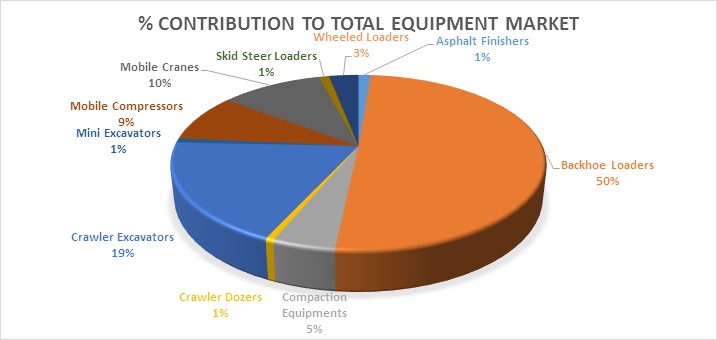
No wonder that the Backhoe Loaders have been the equipment of choice for many over other equipment types. The same is evident from the data recorder by Off Highway research, which proves the higher acceptance of Backhoes as compared to any other construction equipment available in the market today. Backhoes alone comprise of about 50% of all construction related equipment sold in India today (Including Equipment for Road, Cranes, Loading and Excavation)
Even if we compare the contribution of total number of Backhoe loaders to the number of all equipment related to excavation (Crawler Excavator, Wheeled Excavators & Mini Excavators), backhoe loaders have dominated the scenario with a huge margin.
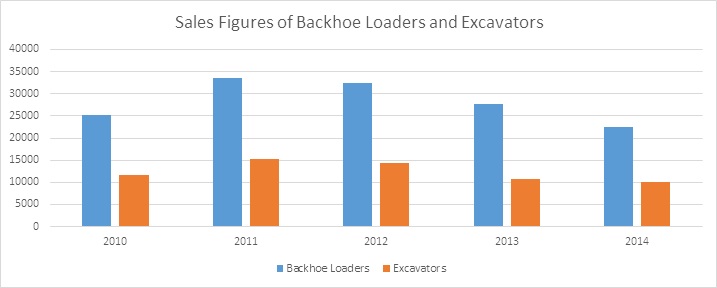
Thus the Backhoe loaders have so far ruled the construction equipment industry and will continue to do so in the foreseeable future, enabling its owners to earn profit through superior return on investments and versatility.
Why the Backhoe loaders are here to stay
Their biggest advantage is that they are compact and consolidate the tools for different jobs like excavating and then loading the same in one unit. Versatility of this particular piece of machinery deserves much more credit than what is bestowed upon it.
Backhoe loaders are commonly used for a wide variety of tasks: construction, small demolitions, and light transportation of building material, powering building equipment, digging holes, breaking asphalt, and paving roads. Replace the bucket with power attachments like breaker, grapple, auger, or a stump grinder and the backhoe can taking on a host of additional tasks on the job site. Versatility is a major plus for this piece of machinery.
The backhoe loader can travel on road and site surfaces. This makes it much easier to have the backhoe working on different tasks on different locations on the construction site. Another plus to the backhoe compared to the excavators which themselves are slow and at times need to be transported.
There is no doubt to it when one claims that backhoe loaders considerably increase productivity thanks to its sheer power and capacity. They are known to be able to carry heavier loads for longer durations of time. Add to it the boom and stick which helps with height, which the excavators lack. It is efficient and saves both time and money when on the job.
Versatility, sheer strength, power and agility already make the backhoe a requisite on construction sites. Add to it the latest available tech and you will know for a fact that the backhoe loader is here to stay.